🧮
Machine Learning
Machine learning is AI where the system learns patterns from examples instead of being manually programmed for every rule. Spam filters, fraud detection, recommendation systems and demand forecasting use this idea.
AI systems work by converting real-world information into data, learning patterns from that data, and using those learned patterns to predict, recommend, classify, generate or automate decisions.
This guide explains AI end to end: what data does, how models are trained, why GPUs matter, how large language models answer questions, what RAG and agents mean, where safety enters the system, and how students should think about AI branches during engineering counselling.
Artificial Intelligence is the broad field of building machines that perform tasks normally requiring human intelligence: perception, language, prediction, planning, reasoning, generation and decision support.
Machine learning is AI where the system learns patterns from examples instead of being manually programmed for every rule. Spam filters, fraud detection, recommendation systems and demand forecasting use this idea.
Deep learning uses neural networks with many layers. It powers modern computer vision, speech recognition, translation, generative AI and large language models.
Generative AI creates new content: text, images, code, audio, video, designs or synthetic data. LLMs are generative AI systems trained heavily on language and code.
This diagram shows the complete AI journey: first define the problem, then collect and prepare data, train the model, test it, deploy it, answer users in real time, and keep monitoring the system.
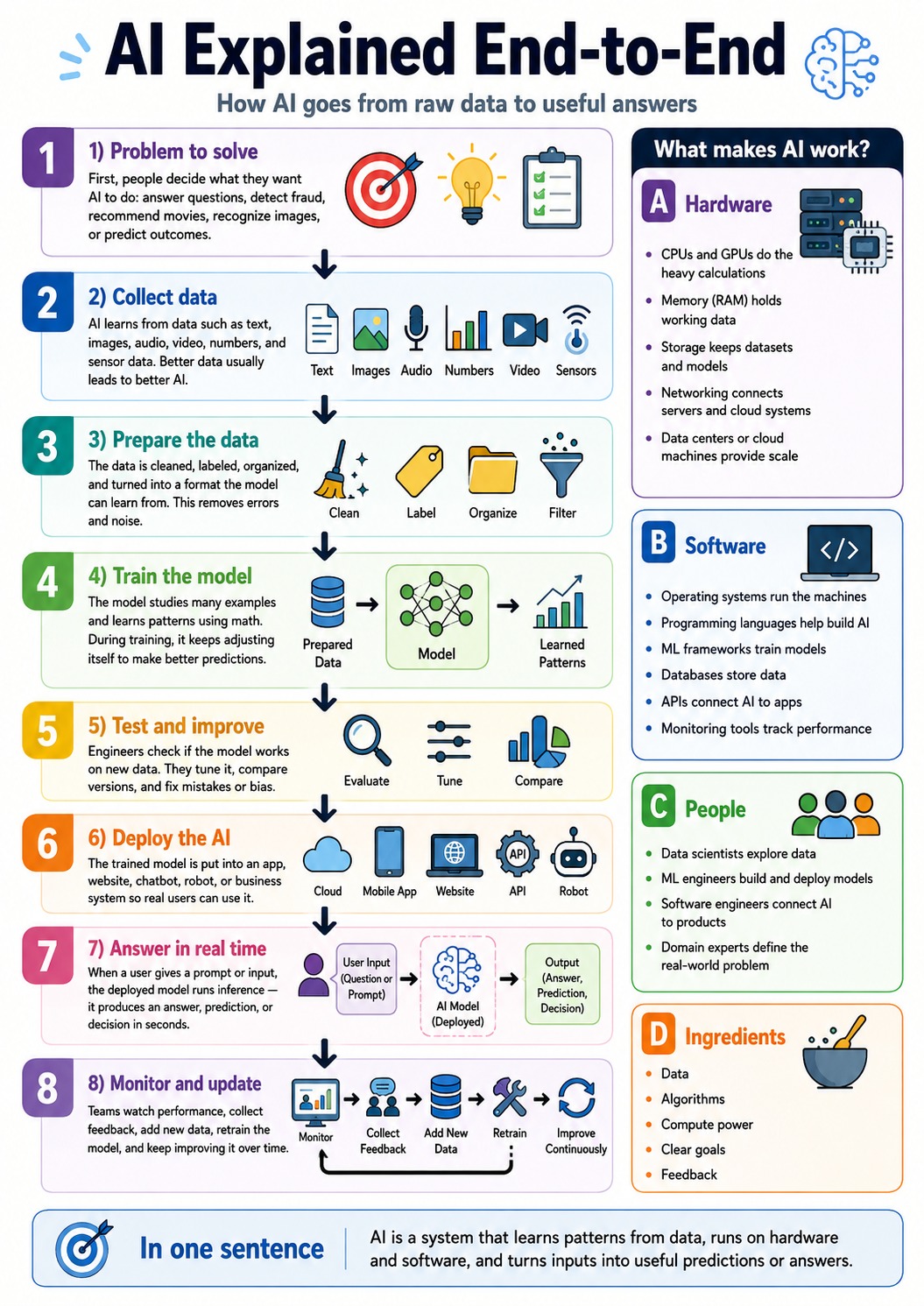
Simple takeaway: AI is not just a model. It is a full system powered by data, compute hardware, software, people, feedback and clear goals. The model is the engine, but the engine needs fuel, roads, controls, safety checks and maintenance.
Students often imagine AI as a single magical brain. In reality, an AI product is a complete system. It has inputs, memory, software logic, compute infrastructure, safety filters, tools, monitoring, and human feedback loops. A good way to understand it is to think of it both as a digital engine and as a car system.
A user gives text, voice, image, video, sensor data or a command. This is the starting trigger for the system.
The chatbot, search box, dashboard, robot console or mobile app receives the input and prepares it for the AI backend.
System instructions, templates, workflow logic and business rules shape what the AI should do.
The system may add previous conversation history, company policies, user profile, or task context.
If the system uses RAG, it fetches relevant knowledge from documents, databases, vector stores or search systems.
This is the central “engine” — an LLM, vision model, speech model or multimodal model that performs reasoning and generation.
The model may call calculators, code tools, web search, CRMs, maps, databases, ERP systems or robotic controllers.
Guardrails check for unsafe content, compliance issues, privacy risks, hallucinations and restricted actions.
The system produces an answer, image, code snippet, recommendation, forecast, classification or control signal.
The output is shown in a readable form — a report, chart, email draft, answer box, assistant reply or action on a machine.
Logs, dashboards and metrics track latency, accuracy, user satisfaction, failure cases, drift and cost.
Human review, user corrections and production data help the system improve over time through tuning, evaluation and retraining.
A car is not just its engine. It also needs fuel, steering, brakes, sensors, a dashboard, roads, servicing and a driver. AI is the same. The model alone is not the full product.
| Car Component | AI System Equivalent | What It Does |
|---|---|---|
| Fuel | Data | Without good data, the system has nothing useful to learn from or retrieve from. |
| Battery / Power Supply | Compute + Electricity + GPUs | AI needs massive computing power during training and fast serving infrastructure during inference. |
| Engine | Foundation Model / Core ML Model | This is the main reasoning or pattern-recognition unit that generates outputs. |
| Transmission | Inference / Serving Layer | Converts model capability into usable output at production speed. |
| Dashboard | User Interface | Shows the system output in a form humans can understand and interact with. |
| GPS / Navigation | Retrieval / RAG / Search | Helps the system fetch external knowledge instead of depending only on the model’s memory. |
| Steering Wheel | Prompts / Workflow Logic / Agent Planning | Guides the AI toward the correct task, tone, sequence and objective. |
| Brakes / ABS | Safety Filters / Guardrails | Prevent harmful, unsafe, non-compliant or low-quality outputs and actions. |
| Sensors | Inputs, APIs, cameras, microphones, documents, enterprise systems | Bring real-world information into the system. |
| Mechanic / Service Centre | MLOps / Monitoring / Engineers / Reviewers | Maintain reliability, fix issues, update models, track failures and improve performance. |
| Driver | User / Product Team / Business Workflow | Defines the goal and decides how the system should be used. |
Students often ask: if AI is an “engine,” what actually powers it? The answer is not just electricity. AI is powered by a combination of compute, data, software systems and human intelligence.
Large AI systems are trained using GPUs, TPUs and high-performance accelerators. Training large models may require thousands of chips working in parallel across data centres.
AI learns patterns from large datasets: text, images, code, voice, transactions, sensor streams, medical records, satellite data and more.
Real AI products run on orchestration software, vector databases, API layers, evaluation systems, deployment pipelines and observability tools.
Humans still drive the highest-value parts: framing the problem, defining rules, evaluating output, fine-tuning behaviour and correcting mistakes.
During training, AI is like a car being designed and tested in a factory. Engineers build the architecture, feed it data, run compute at scale, test quality, and improve it repeatedly.
During inference, AI is like the car already on the road. The user turns the key with a prompt, the system reads the situation, chooses the right route, uses tools if needed, applies brakes if necessary, and delivers an output.
A serious AI product is not just a model. It is a production system with data pipelines, training, evaluation, deployment, monitoring, security and feedback loops.
First define the task: predict exam demand, classify images, detect fraud, recommend colleges, answer questions or generate text. Bad problem definition creates expensive nonsense. Very polished nonsense, but still nonsense.
The system gathers data from databases, documents, sensors, websites, transactions, user behaviour, images, audio, videos or expert-labelled examples.
Raw data is messy. Engineers remove duplicates, handle missing values, standardise formats, label examples, split data into training/validation/test sets and check for bias or leakage.
Traditional ML converts data into features. LLMs convert text into tokens. Images may become pixels or patches. Audio becomes waveforms or spectrograms. The machine needs numbers, not vibes.
The model sees examples, makes predictions, calculates error and updates internal weights repeatedly. This is usually done on GPUs/TPUs because training needs massive parallel computation.
The team tests accuracy, precision, recall, latency, robustness, fairness, hallucination rate, cost and failure cases. A model that performs well in demos may still fail in production.
The model is wrapped inside an application or API. It may run in the cloud, on a phone, inside a car, at a factory, in a hospital system or on an edge device.
Inference is the live use stage. A user gives input, the system processes it, the model produces output, and the application shows a result, recommendation, answer or action.
After launch, engineers track errors, drift, cost, user satisfaction, abuse, safety issues and changing data patterns. AI systems decay if nobody watches them.
The model gets the publicity. The surrounding infrastructure often decides whether the product actually works.
| Part | What it does | Typical skills involved |
|---|---|---|
| Data layer | Stores and moves data from sources into usable training or retrieval pipelines. | SQL, data engineering, APIs, ETL, cloud storage, data quality checks. |
| Labelling layer | Creates ground-truth examples for supervised learning and evaluation. | Annotation design, domain expertise, quality control, sampling. |
| Model layer | Learns patterns and produces predictions, classifications or generated outputs. | ML, deep learning, statistics, Python, PyTorch/TensorFlow, optimisation. |
| Training infrastructure | Runs large-scale training jobs on GPUs/TPUs and tracks experiments. | Distributed systems, CUDA awareness, MLOps, experiment tracking. |
| Evaluation layer | Checks quality, errors, bias, hallucinations, latency and cost before release. | Metrics, test sets, red-teaming, statistics, domain review. |
| Application layer | Turns model output into a product users can actually use. | Frontend, backend, API design, UX, security, product engineering. |
| Monitoring layer | Detects failures after deployment and sends feedback for improvement. | Observability, logging, analytics, incident response, retraining triggers. |
Swipe table horizontally on mobile.
AI is not one subject. It is a stack: mathematics, programming, data, modelling, systems, deployment and responsible use. A serious AI curriculum should show depth across all layers.
| Year | Core academic focus | Tools and projects students should build | Career signal by end of year |
|---|---|---|---|
| Year 1 | Calculus, linear algebra, probability basics, programming, physics, communication and engineering foundation. | Python, Git/GitHub, basic data analysis, small scripts, simple web/API project, coding practice. | Comfort with coding and mathematics. No shortcuts here; weak foundations make AI look like magic tricks. |
| Year 2 | Data structures, algorithms, discrete maths, statistics, databases, optimization and software engineering basics. | Data-cleaning projects, SQL dashboards, algorithmic problem solving, mini ML models, Kaggle-style notebooks. | Ability to handle data and write clean code. This is when the student stops being a tutorial tourist. |
| Year 3 | Machine learning, deep learning, NLP, computer vision, big data systems, cloud basics, evaluation and experimentation. | End-to-end ML app, model training pipeline, retrieval-based chatbot, computer vision classifier, internship/research project. | Portfolio with working systems, not just certificates. Internship readiness starts here. |
| Year 4 | Generative AI, transformers, MLOps, distributed training/inference, model monitoring, responsible AI, privacy and advanced electives. | Production-style AI system with API, vector database, evaluation suite, monitoring, documentation, capstone or thesis. | Placement or higher-study readiness: ML engineer, data scientist, AI engineer, research engineer or software engineer with AI specialization. |
| Dual degree / fifth year, where applicable | Advanced specialization: research, optimization, theoretical ML, systems, robotics, language models, vision, scientific AI or domain AI. | Thesis, publishable research, deep industry internship, large-scale AI system or specialized domain project. | Stronger research/MS/PhD/advanced R&D signal, but only if the extra year is used seriously. |
Swipe table horizontally on mobile.
AI hiring is spread across product companies, cloud providers, fintech, GCCs, analytics firms, consulting, semiconductor companies and AI-native startups. The role name matters less than the work: data pipelines, model building, evaluation, deployment and measurable business impact.
| AI space | Representative companies | Common hiring locations in India | Typical work |
|---|---|---|---|
| Big Tech / Cloud AI | Google, Microsoft, Amazon/AWS, IBM, Oracle, SAP, Salesforce, Adobe, Atlassian. | Bengaluru, Hyderabad, Pune, Chennai, Delhi NCR, Mumbai, Noida, Gurugram. | AI platforms, cloud ML services, search/recommendation, applied ML, software engineering with AI features. |
| AI-native and product startups | Krutrim, Sarvam AI, Ola, Razorpay, PhonePe, Meesho, Swiggy, Zomato, Freshworks, Zoho, SaaS and vertical-AI startups. | Bengaluru, Hyderabad, Chennai, Pune, Mumbai, Delhi NCR. | LLM applications, RAG systems, personalization, fraud/risk models, automation, analytics products. |
| Analytics / data science firms | Fractal, Tiger Analytics, Mu Sigma, EXL, ZS, Quantiphi, LatentView, Tredence, Course5, Ugam/Merkle. | Bengaluru, Chennai, Mumbai, Pune, Gurugram, Noida, Hyderabad. | Forecasting, customer analytics, pricing, experimentation, dashboards, ML models and business decision systems. |
| Finance / fintech / GCC AI | Goldman Sachs, JPMorgan, Morgan Stanley, Citi, Barclays, Wells Fargo, American Express, PayPal, Visa, Mastercard, Razorpay, PhonePe. | Bengaluru, Mumbai, Hyderabad, Chennai, Pune, Noida, Gurugram. | Risk models, fraud detection, trading/data platforms, credit analytics, cybersecurity, automation and AI-assisted operations. |
| Semiconductor / hardware AI | Nvidia, Intel, AMD, Qualcomm, Texas Instruments, Samsung Semiconductor, Micron, Synopsys, Cadence, KLA, Applied Materials. | Bengaluru, Hyderabad, Noida, Chennai, Pune, Delhi NCR. | AI chips, GPU/software stacks, embedded AI, edge AI, compilers, verification and hardware-aware ML systems. |
| Consulting / enterprise AI | Accenture, Deloitte, EY, PwC, KPMG, McKinsey, BCG, Bain, Capgemini, Cognizant, Infosys, TCS, Wipro, HCLTech. | Bengaluru, Mumbai, Pune, Hyderabad, Chennai, Delhi NCR, Kolkata. | Enterprise AI implementation, automation, data modernization, analytics strategy, model governance and responsible AI. |
Swipe table horizontally on mobile.
The strongest students can explain the full system: data source, preprocessing, model choice, training method, evaluation metric, failure cases, deployment cost, monitoring and safety. Saying “I know GenAI” without this chain is just LinkedIn perfume.
A large language model predicts likely next tokens based on patterns learned during training. The impressive part is that, at scale, this token prediction can support translation, coding, summarisation, reasoning-like behaviour and conversational assistance.
Text is broken into tokens: words, word-pieces or characters. The model processes token IDs, not raw human text.
The model learns broad language and world patterns from large text and code datasets by predicting missing or next tokens.
The base model is tuned to follow instructions, answer safely, refuse harmful requests and match the expected product behaviour.
The prompt, conversation and retrieved documents fit into a context window. The model uses that context to produce the next answer.
The system chooses output tokens using settings such as temperature, top-p and constraints. Lower randomness gives more predictable answers.
LLMs are tested on factuality, reasoning, coding, safety, bias, latency, cost and task-specific benchmarks.
Many production AI systems do not rely only on model memory. They retrieve current information, call tools, query databases and follow workflows.
RAG lets an AI system search a trusted knowledge base before answering. For example, a college analytics system may retrieve official cutoffs, branch data or internal rules, then ask the model to produce a user-friendly answer.
An agent-like system can plan steps and call tools: search the web, read files, run code, query a database, send an email, update a CRM or generate a report. The model becomes a controller inside a larger software system.
AI is useful, but it is not automatically reliable. The failures are predictable enough that serious teams design around them.
Biased, outdated, incomplete or leaked data creates bad outputs. The model may look smart while learning the wrong pattern.
Generative models can produce confident but false answers, especially when they lack reliable context or are pushed beyond their knowledge.
AI systems may expose sensitive data, follow malicious prompts, call tools incorrectly or become attack surfaces if poorly designed.
Systems can perform differently across groups if training data, labels or deployment context are skewed.
Large models can be expensive and slow. Production teams optimise model size, caching, batching and hardware.
High-stakes use cases need review, escalation paths, logs and accountability. “The AI said so” is not a governance model.
AI is not only one branch. It sits across computer science, mathematics, statistics, electronics, electrical, robotics, mechanical systems, biomedical data, economics and domain engineering.
| Branch / background | AI fit | Best skill stack |
|---|---|---|
| CSE / IT / Software | Strongest direct route into AI engineering, ML systems and product engineering. | Python, DSA, ML, deep learning, databases, cloud, MLOps, systems. |
| AI / Data Science / MnC | Excellent for ML, data science, quant, algorithms and model-building roles. | Linear algebra, probability, statistics, optimisation, Python, ML projects. |
| ECE / Electrical / Instrumentation | Strong for embedded AI, robotics, edge AI, chips, sensors, signal processing and autonomous systems. | C/C++, Python, signal processing, control systems, embedded systems, ML. |
| Mechanical / Aerospace / Robotics | Useful for robotics, simulation, autonomous vehicles, drones, manufacturing analytics and digital twins. | Controls, robotics, CAD/simulation, Python, ML, optimisation. |
| Biotech / Biomedical / Chemical | Useful for bioinformatics, drug discovery, medical AI, process optimisation and lab automation. | Statistics, Python, domain biology/chemistry, ML, data cleaning. |
| Civil / Environmental / Energy | Useful for smart infrastructure, climate modelling, geospatial AI, demand forecasting and energy optimisation. | GIS, statistics, Python, optimisation, domain modelling, ML. |
Swipe table horizontally on mobile.
AI branch names are everywhere now. Some are excellent. Some are marketing with a syllabus attached. Verify before you pay four years of fees.
| Question | Why it matters |
|---|---|
| Is the curriculum mathematically serious? | Real AI needs probability, statistics, linear algebra, optimisation and algorithms. |
| Does it include core CS? | AI engineers still need programming, data structures, databases, operating systems and software engineering. |
| Are there good faculty and labs? | Projects, research, mentorship and internships matter more than brochure language. |
| Do AI/data recruiters visit the campus? | Placement access is institute-specific. A branch name does not guarantee recruiter access. |
| Can students sit for CSE/software roles? | This matters if your goal is software or product engineering, not only pure ML research. |
| Are students building projects? | AI hiring heavily rewards demonstrable work: models, apps, papers, Kaggle, GitHub, internships. |
AI is a system: data → preparation → model → training → evaluation → deployment → inference → monitoring. The best students understand both the mathematics and the engineering. They can build models, but they can also ship usable products.
For counselling, AI/Data Science/MnC/CSE are strong options when the curriculum and institute are strong. ECE, Electrical, Instrumentation, Robotics and core engineering branches can also lead to AI careers when the student builds coding, maths and domain projects.
For deeper study, students can review AICTE model curriculum resources, official institute syllabi, introductory machine learning courses, Python programming, probability, statistics and linear algebra.
For a more formal view of AI systems, curriculum and responsible AI, students should check official and institutional sources rather than relying only on social-media summaries.